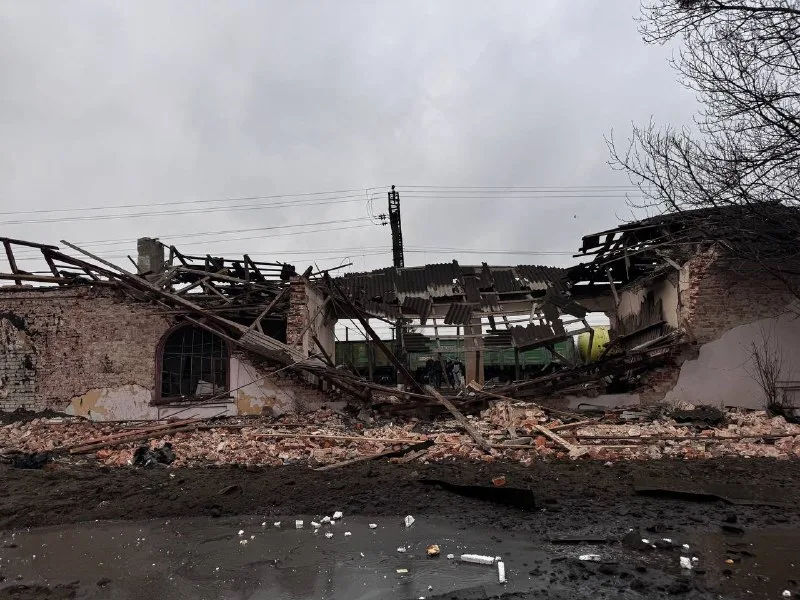
Two people were killed and ten taken to hospital after a Russian strike hit Skniliv railway station in Lviv on the morning of 20 November, Mayor Andriy Sadovyi said after the city's emergency commission met. The station's ticket terminal was destroyed, a dormitory was damaged and parts of the city briefly lost water pressure and electric transport.
Key facts
- Two dead, ten in hospital: four of the injured were treated and sent home, six remain in hospital and two of them are in a serious condition, according to the mayor. The count rose through the morning: at 09:33 the head of the Lviv Regional Military Administration, Maksym Kozytskyi, put the number of injured at seven.
- Station and road wrecked: the worst damage is around Aviatsiina Street, where the Skniliv station building and the road surface were hit. The street is closed until police finish their work and the city can clear it.
- Dormitory hit: about 35 residents live in a damaged dormitory. The city is offering them places in other dormitories or hotels.
- Debris across the city: on Lazarenka Street fragments damaged five cars and a children's playground; in the village of Lysynychi a house roof was damaged.
- Water and transport: strikes on the region's energy system cut power to pumping stations and disrupted trams and trolleybuses for a time. Water now reaches all buildings, but upper floors on several streets may get lower pressure, Sadovyi said.
Context
The strike was part of the night's massive Russian attack, nearly 500 missiles and drones aimed above all at Ukraine's power grid. Early in the morning Ukrenergo imposed emergency power cuts in the Lviv, Zakarpattia and Ivano-Frankivsk regions to keep the grid stable.
Lviv is about 70 km from the Polish border and is Ukraine's main western gateway: many foreign visitors, journalists, aid workers and business travellers arriving by rail from Poland change trains here. Russia has struck Ukraine's railways throughout the full-scale war, because they carry passengers, evacuees, humanitarian cargo and the country's exports. A hit on a ticket hall, where people queue, is a hit on civilians.
Why it matters
The far west has become the place where foreign companies and relocated Ukrainian businesses set up because it was considered the safest part of the country. Strikes like this one show that no region is out of reach, and they hit exactly the infrastructure that connects Ukraine to the EU. Travellers should expect delays on routes through Lviv and follow air-raid alerts and instructions from railway staff.
What's next
The city will clear Aviatsiina Street once police allow it, survey damaged buildings and help residents with paperwork for compensation. Sadovyi said damaged windows and doors will be closed up at least temporarily before the cold sets in.
Sources
- Andriy Sadovyi, Mayor of Lviv — Уточнена інформація про наслідки атаки на Львів
- Andriy Sadovyi, Mayor of Lviv — Влучання у квитковий термінал станції Скнилів
- Andriy Sadovyi, Mayor of Lviv — Водопостачання у Львові
- Maksym Kozytskyi, Lviv Regional Military Administration — Кількість постраждалих зросла до семи
- Ukrenergo — Аварійні відключення у Львівській, Закарпатській та Івано-Франківській областях